December 15, 2009
True story. It is a cold wintery morning and a man with a violin standing in the Washington DC Metro Station plays six
pieces written by Bach. This takes 45 minutes. Four minutes after he begins playing, he receives his first dollar from a woman who throws the money into his hat and continues to walk. For the next six minutes a young man stops briefly to listen, along with several children who try to stop, but are forced to move on quickly by their parents. For 45 minutes this musician plays continuously. Twenty gave money, but continued to walk at their normal pace. The man collected a total of $32. When he finished playing – no one noticed. Silence simply took over.
The violinist playing that morning was Joshua Bell, one of the greatest musicians in the world. The average cost of a ticket to see him in concert is $100. That morning in the Metro Station, he played one of the most intricate pieces of music ever written on a violin valued at $3.5 million dollars.
Joshua Bell played in the Metro Station as part of a social experiment about perception and people’s priorities. The questions raised from this experiment were these: in a commonplace environment at an inappropriate hour, do we perceive beauty? Do we stop to appreciate it? Do we recognize something or someone as a gift when it or they are offered in an unexpected context?
We have entered a Holiday season that can easily throw all of us into a faster pace and a higher level of stress. I am wondering if we intentionally chose to slow down – if we made personal choices around our priorities – if we simply made the effort to pay attention to what’s around us - what precious gifts might each one of us find?
With that thought in mind – Merry Christmas.
December 2, 2009
I’m never quite sure what it really means to everyone else in our
organization, but one of the annual traditions we have established at SONM that I really enjoy is honoring our Distinguished Service Award winners. The ceremony itself is somewhat ”relaxed,” but the sentiment in which the awards are given is as sincere as it gets.
If you look up the definition of distinguished it reads ”characterized by excellence or distinction; of great significance or value.” If I were to write my own definition it would include “farther reaching – longer lasting.”
There are thousands in New Mexico who serve our athletes in a variety of ways and at a variety of levels. To render distinguished service to others each of us must choose to add something that only we can offer – more of ourselves. For those who were honored this year – thank you again. We continue to celebrate you, because who you are in the choice you made has made us better.
November 18, 2009
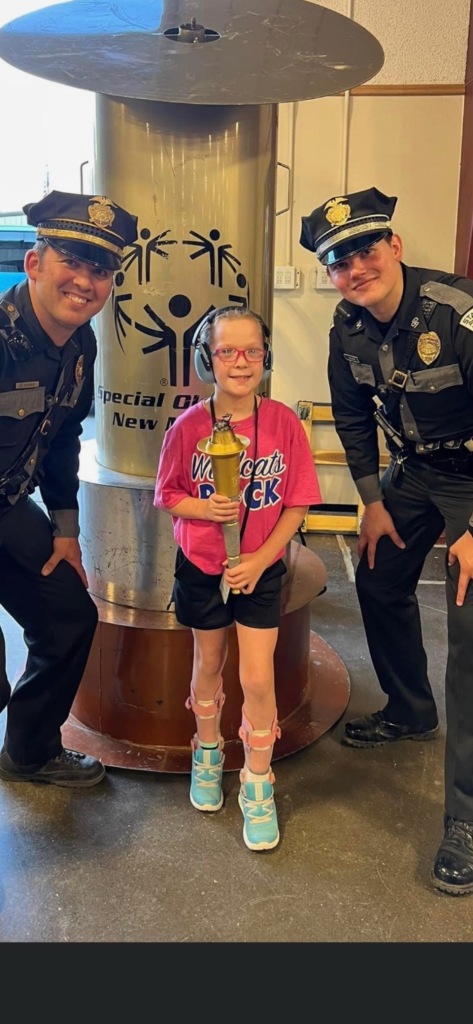
Last week I had the priviledge of attending the 2009 Law Enforcement Torch
Run International Conference in Connecticut. Eleven law enforcement officers from New Mexico were in attendance - each having raised a minimum of $7,500 on behalf of our athletes. This year’s Torch Run generated over $34 million world-wide - $91,000 more than last year. You really can’t say enough about the amazing success our officers have had raising money, and it is no secret that if it were not for the Torch Run, Special Olympics would not be anywhere close to what it is today. Having spent the week being ”inspired, motivated, and educated” as I listened to the stories of these dedicated servants, I returned to New Mexico with a deeper appreciation of the following:
The men and women in our cities and towns who carry the Flame of Hope for miles and miles run so that ignorance, judgment, cruelty, and the fear of difference will eventually disappear. The flame that burns in their hearts is what brings light to people’s darkness. It is the light that shines in each law enforcement Torch Runner that allows Special Olympics athletes to be seen unmistakably with dignity and respect.
Shawn Archuleta, John Francis, Jennifer Dennis, Robert Miller, Charlie Gonzales, Mike Miyagishima, Amanda Valencia, Michelle Ugalde, Bruce Pratz, Matt Elwelle, and Gerald Sandoval and every New Mexico law enforcement officer who participated - thank you for changing lives – thank you for changing attitudes- thank you for the reasons in your heart that inspire you to be the Guardians of our Flame. You give us hope.
November 3, 2009
My grandmother weighed about 100 pounds, smoked like a steam engine, and in my min
d’s eye wasn’t exactly “athletic,” but the woman could flat out bowl. She had a closet full of bowling shirts, bowling shoes in a variety of colors, and two bowling balls, which she carried in beautiful leather bags. She bowled in a league and cherished her “bowling night” like no other night of the week.
As I got older, I would debate with my grandmother whether bowling was even a sport. “It is a recreational GAME,” I would tell her. “Basketball, track, volleyball, cycling – those are sports. You can’t eat, drink, and carry on conversation while competing in a sport!” “Balance, coordination, strength, and skill are all key ingredients of a sport,” she would say. We debated for years, until I realized that no matter how she or I chose to categorize it - bowling was then and continues to be one of America’s most enjoyable past-times!
In the next three weeks 742 Special Olympics New Mexico bowlers will compete at the North Regional Bowling Tournament in Albuquerque and the Holiday Classic in Las Cruces. That would be almost 200 more athletes than last year. More participants – more dreams fulfilled – more happy moments – more friendships made – more families celebrating – more volunteers learning – more communities involved. Sport, game, or just maybe a little of both, Special Olympics bowling is offering our athletes and everyone else who shows up a time of accomplishment, fun, and celebration.
With a smile on my face and fond memories of my grandmother, I look forward to seeing you on the lanes.
October 18, 2009
Special Olympics is all about creating new possibilities for any person who
walks onto our playing fields. We spend a lot of time trying to articulate what those opportunities bring to the lives of our Special Olympics athletes. Today however, I want to share with you words I received in a card from Marla Wood, a friend of our organization who raised money to support our athletes by going Over the Edge.
“Dear Randy. I’ve been thinking for a few weeks just what it is I have to say about going Over the Edge. When you were telling me about the event a month ago, I was so excited and raring to go! And as Bruce and his office got geared up and shaved off, I started getting fidgety. On the balcony of Meyners and Company with you sharing stories of Media Day, and me looking down a mere eight stories, I wondered what I had gotten myself into. I felt the rumblings of fear, the voices of doubt, and finally, on that Friday morning, the rush of fight or flight adrenaline. I was terrified – and excited – and so afraid – less of hurting myself and more of embarrassing myself with cowardice.
But I did it. With all of those smiling faces and words of encouragement and statements of surety from so many volunteers – I did it! I made it to the ground and people unbuckled me and unradio’ed me, while people I’ve never met yelled and clapped for me. And then the sweetest soul put a gold medal around my neck. What a moment.
It took about 15 minutes of wandering around, thanking folks, trying to focus, and then watching Francie come down that wall – and I couldn’t stop the tears. I sat on the curb and cried. There are people for whom this sort of feat might be no big deal, but it was for me. Just like running and swimming and jumping might be a minimal event for me, it is a monumental accomplishment for those who find challenge there. So, thank you. To all of the volunteers - from the folks storing my stuff in a bag, to the guys buckling me in, to the fellow on the roof holding my sunglasses – thank you. Thank you for this new clarity of thought on just what courage means.”